
Today, almost everything in human life is organised around a 24-hour day. People wake up, go to work, attend school and sleep according to a cycle that seems as natural as sunrise and sunset.
But Earth has not always had days of this length.
Scientists believe that around one billion years ago, a day on Earth lasted approximately 19 hours. The reason lies in a remarkable relationship between our planet and its nearest celestial neighbour, the Moon.
When Earth formed approximately 4.5 billion years ago, it rotated much faster than it does today. A complete rotation around its axis took considerably less time.
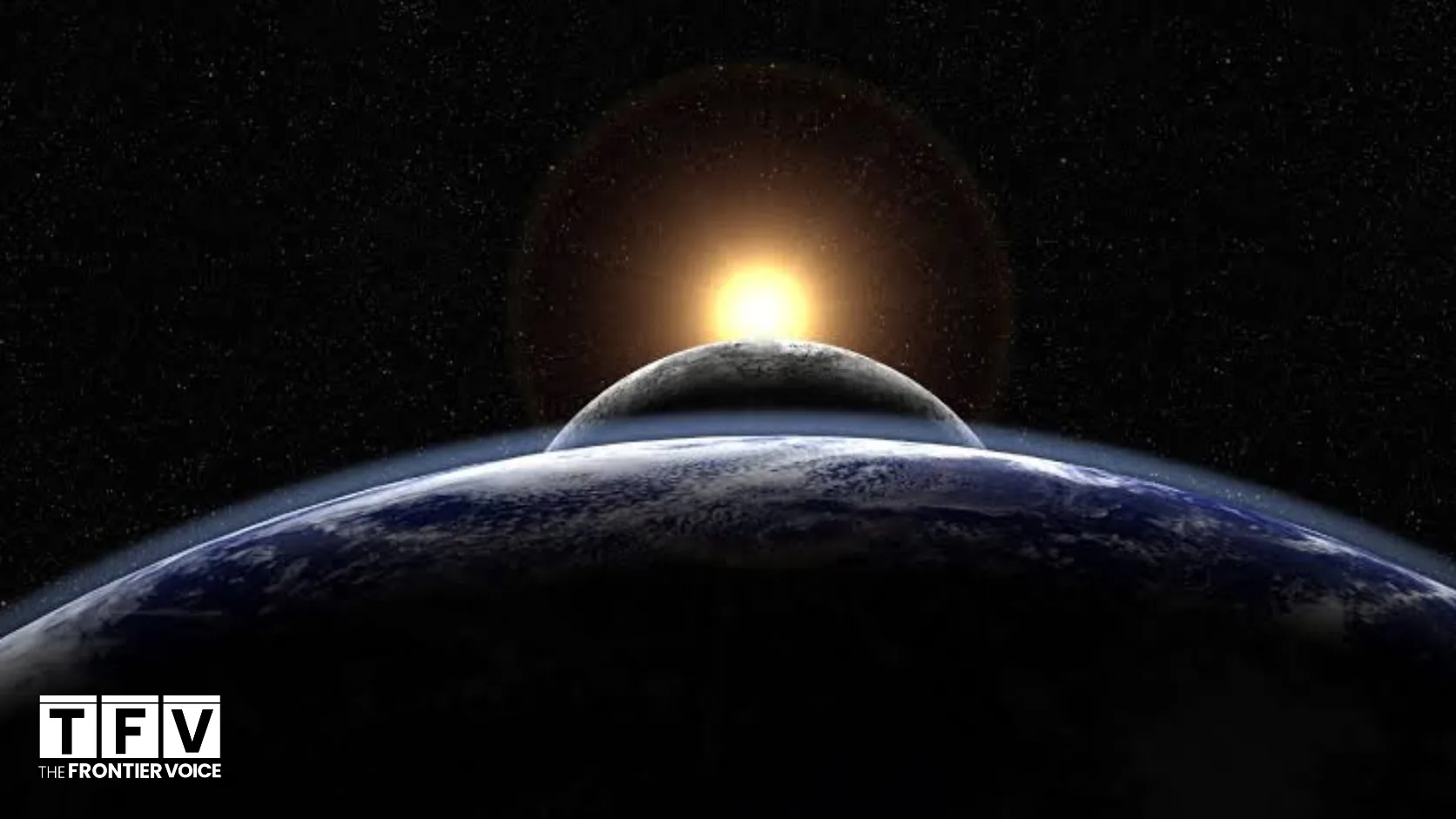
Over billions of years, however, the Moon's gravitational influence gradually slowed Earth's rotation.
The process is closely connected to ocean tides.
The Moon's gravity pulls on Earth's oceans, creating tidal movements. Because Earth rotates while these tidal bulges interact with the Moon's gravitational field, friction transfers rotational energy away from Earth.
As a result, our planet gradually loses some of its rotational speed.
The Moon is also slowly moving away from Earth. According to measurements made by scientists using laser reflectors placed on the lunar surface, it is currently receding at approximately 3.8 centimetres every year.
Researchers have studied ancient geological formations, sedimentary deposits and fossils to reconstruct the history of Earth's rotation.
These investigations suggest that Earth's day length was around 19 hours approximately one billion years ago. Over geological time, the length of a day gradually increased towards the 24-hour cycle familiar today.
The process has not stopped.
Earth's rotation continues to change, although the variations are extremely small on human timescales. Atmospheric movements, ocean circulation, earthquakes and changes in the planet's internal structure can also influence the length of a day.
Scientists study these variations because accurate measurements of Earth's rotation are important for navigation, satellite systems and timekeeping.
The relationship between Earth and the Moon also helps researchers understand how planetary systems evolve over billions of years.
What makes this discovery fascinating is the idea that something as familiar as a day is not a fixed feature of our planet.
The 24 hours we take for granted are the result of an extraordinary cosmic history, shaped by gravity, oceans and the slow movement of two worlds through space.