

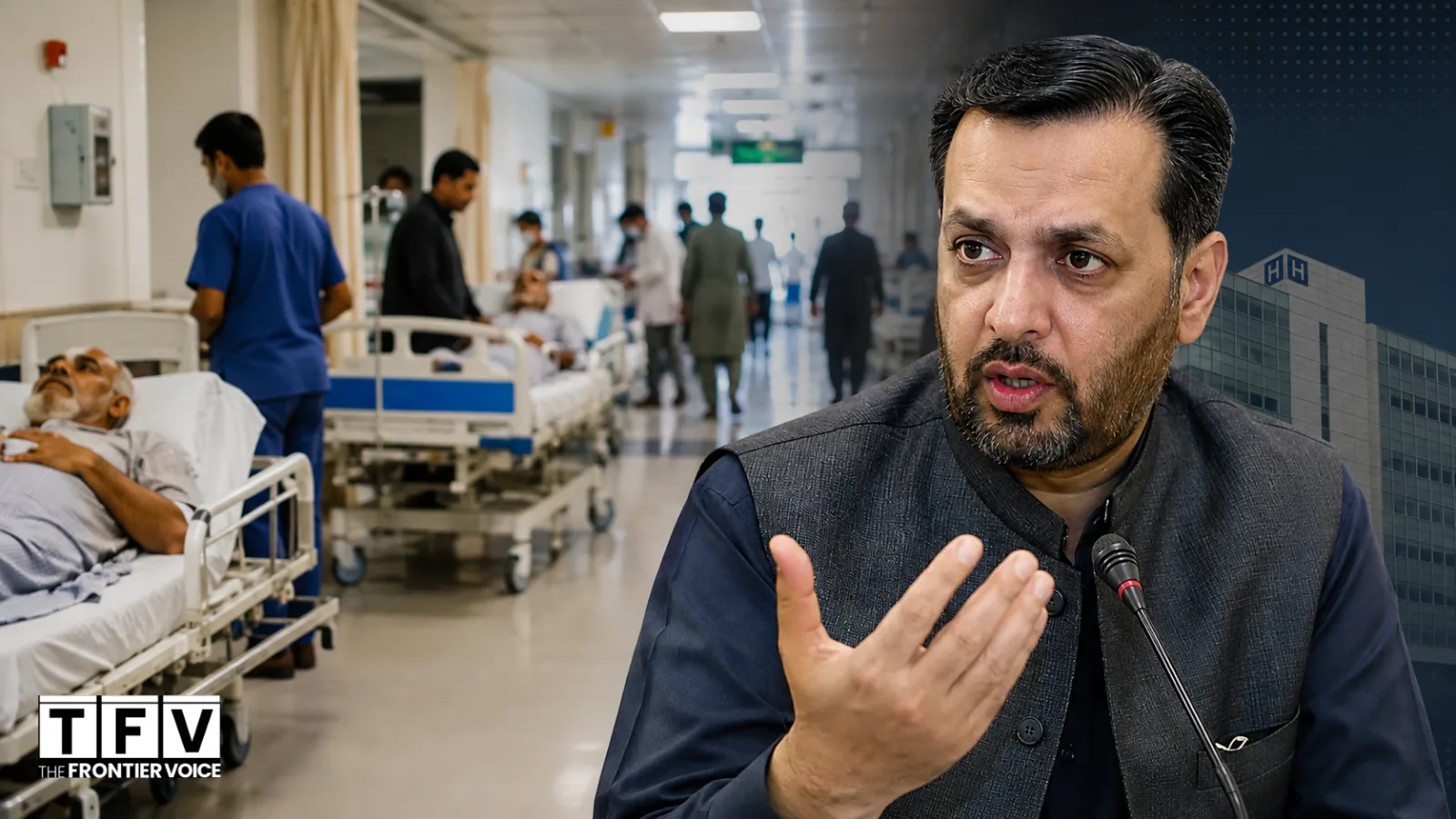
ISLAMABAD: Federal Health Minister Mustafa Kamal has called for major reforms in Pakistan’s public healthcare system, arguing that the government should not directly run public hospitals under the existing administrative structure.
Speaking during a meeting of the Senate Standing Committee on Health, Kamal said the system at the Pakistan Institute of Medical Sciences (PIMS) had deteriorated to such an extent that meaningful improvements were difficult under the current arrangement.
“Government should not run public hospitals,” the minister said, questioning what the public receives from the existing system despite the huge amount allocated to healthcare.
The meeting focused extensively on the recent fire incident at PIMS, fire safety arrangements, regulatory inspections, hospital administration and the broader healthcare system.
Questions Raised Over PIMS Fire Safety
The committee expressed serious concern over the PIMS incident and questioned whether adequate safety and emergency systems were in place.
Committee members also discussed a fire that broke out at the nurses’ hostel on July 6 and raised allegations that the incident was not promptly reported to the health minister and that evidence had allegedly been compromised.
Kamal told the committee that he had initially been informed that a spark from an air conditioner had caused the fire. He later learned that the air conditioner itself was faulty.
According to the minister, it took approximately 120 seconds for the fire to spread throughout the room after the first spark.
The committee questioned why proper fire-management and emergency systems had not prevented the situation from escalating.
When Was PIMS Last Inspected?
A major point of concern was the regulatory oversight of PIMS.
Officials from the Islamabad Healthcare Regulatory Authority (IHRA) were questioned about the last inspection of the hospital. The committee was told that PIMS had not been visited by IHRA during the previous two years.
The revelation prompted strong criticism from committee members, who questioned the effectiveness of the regulatory authority if major public hospitals were not being regularly inspected.
The committee also raised concerns regarding a possible conflict of interest involving the leadership of the regulatory authority, after members were informed that the authority’s chairman had links to private healthcare and educational institutions.
Senator Rubina Khalid called for the authority to be abolished, questioning its effectiveness and regulatory role.
‘PIMS System Has Become Rotten’
Mustafa Kamal argued that PIMS required a fundamental restructuring rather than minor administrative adjustments.
He proposed bringing professional leadership from the market, appointing officials on the basis of performance and giving the chief executive officer sufficient powers to run the institution effectively.
The minister said the existing PIMS Ordinance restricted certain appointments from outside the institution, making structural reform difficult.
He described PIMS as having effectively become a “jagir” and said radical reforms were needed to break the existing administrative structure.
Rs1,556 Billion Health Budget Under Scrutiny
The health minister also questioned the effectiveness of Pakistan’s overall healthcare spending.
He said the country currently has a health budget of Rs1,556 billion, yet the public continues to face serious difficulties in accessing quality healthcare.
Kamal claimed that research conducted by his side suggested that approximately Rs210 billion could provide universal health facilities to people across the country.
He argued that instead of the government directly operating large numbers of public hospitals, a broader healthcare model could provide coverage through a much larger network of hospitals.
Senate Committee Demands Accountability
The Senate committee expressed dissatisfaction with the performance of several institutions involved in the PIMS matter and called for greater transparency and accountability.
The committee sought details from the relevant authorities regarding how many healthcare units had been sealed during the previous year and how many were subsequently reopened.
The committee also emphasized the need for effective fire safety, regulatory inspections, emergency preparedness and patient protection across hospitals.
The meeting has placed renewed focus on the question of whether Pakistan’s public hospitals need better management—or an entirely different operating model.